
1、Why Did Our HMI Cover Glass Fail After 6 Months? — The Call No One Wants to Get
That phone call always comes at the worst possible time.
Your customer’s production line is down.
The HMI display on their mission-critical equipment is showing spider-web cracks across the corner.
The screen is unreadable.
The machine is idling.
Operators are standing around.
And someone is asking: “Who supplied this glass?”
If you’ve spent any time in industrial manufacturing, you’ve either gotten that call—or made it.
The immediate reaction? Blame the glass. Order a thicker piece. Swap to a “better” material, or find a cheaper vendor to cut losses.
Here is what 15 years on the factory floor actually taught us: That cover glass didn’t fail because it was “bad glass.”
It failed because it was the wrong material for the environment—and the supplier either didn’t know the difference or didn’t care to tell you.
This guide is here to make sure you never take that call again.
2、Why Is Industrial HMI Glass Not “Phone Glass”?
Let’s clear up the biggest misconception right out of the gate.
When procurement teams hear “Gorilla Glass” or “chemically strengthened glass,” the default reaction is: “Great.
Same stuff as my smartphone. Proven tech.”
That assumption is where the hidden risk begins.
| Feature | Consumer Smartphone Cover | Industrial HMI Cover |
| Operating Environment | Indoor, pocket, desk, controlled climate | Factory floors: dust, vibration, -20°C to +70°C, 24/7 runtime |
| Primary Failure Mode | Drop impact → shattering | Micro-crack propagation → delayed fracture, delamination, chemical breakdown |
| Expected Lifespan | 2–3 years | 7–10 years (or match the machine’s lifecycle) |
| Inspection Standard | AQL sample check | 100% full inspection + environmental stress testing |
| Consequence of Failure | Personal inconvenience | Line shutdown, safety hazard, brand reputation hit |
A smartphone screen dying after two years is annoying.
An industrial HMI cover failing after six months is a disaster.
The engineering bar isn’t just “tougher”—it’s a completely different game.
3、What Are the Three Materials That Actually Work on Factory Floors?
Here is what standard spec sheets leave out: every material is a compromise.
Your job as a buyer or engineer isn’t to find the “perfect” material; it’s to find the least wrong one for your specific application.
| Material | Hardness (Scratch Resistance) | Impact Resistance | Max Service Temperature | Transparency | Relative Cost | Best Application |
| Gorilla Glass | Excellent (Mohs 6-7) | Moderate | ~400°C | Excellent (>92%) | High | Premium HMI, medical devices, outdoor touch panels |
| Chemically Strengthened Glass | Good (Mohs 5-6) | High | ~300°C | Excellent (>91%) | Medium-High | Industrial controls, automotive displays, harsh environments |
| Acrylic (PMMA) | Moderate (Mohs 2-3) | Low (brittle, snaps under stress) | ~80°C–90°C | Excellent (92%, actually clearer than glass) | Low | Budget-sensitive projects, indoor non-touch applications |
4、🧪 Factory Floor Insight #1: How to Tell PC from Acrylic in 3 Seconds — No Tools Required
Spec sheets can spin things, but physics doesn’t lie.
If you are ever holding a sample and aren’t sure whether it’s polycarbonate (PC) or acrylic (PMMA), ignore the label and look at the cut edge:
-
Acrylic (PMMA): The edges are crystal-clear, ranging from water-white to pure black and other colors. Bend it—it will spring back, then snap cleanly in two. This is a normal characteristic of glass-hard sheets.
-
Polycarbonate (PC): Slightly yellowish and pale blue at the edges, with a milky white color. Flex it—it bends and warps, but it won’t snap. That is the indestructible toughness PC is known for.
Why this impacts your purchasing order:
Acrylic can be laser-cut with a smooth, flame-polished edge, ready to pack right off the bed.
PC turns yellow and kicks up black smoke under a laser beam; it demands CNC milling, which tacks on extra processing time, tool wear, and labor costs.
That distinction should show up clearly on your itemized quote.
When a supplier quotes you the exact same price for both options without mentioning the fabrication gap, they are either inexperienced or keeping cards close to their chest.
5、What Is the Hidden Cost of “Good Enough” Glass?
We’ve seen procurement teams celebrate saving 15% on unit price, only to eat a 50% loss later in total cost of ownership.
Here is what “cheap” glass actually buys you:
| Hidden Cost | Real-World Impact |
| Micro-cracks from lazy cutting | Hidden edge cracks propagate under constant machine vibration →field failure in 3–6 months → line downtime + ruined customer trust |
| Weak silk-screen adhesion | Logos or legends wash off after exposure to industrial cleaning solvents → HMI becomes unreadable → whole front panel scrapped |
| Sloppy thickness tolerance | Cover glass fails to seat flush against the capacitive touch sensor → touch responsiveness drops → operator frustration |
| Skipped annealing internal stress | Glass develops delayed micro-fractures during transit or assembly → unexpected replacement fees + customer site penalties |
| Zero material traceability | A bad batch hits the floor, but you can’t trace the raw material lot → you have no way to stop it from happening again on the next run |
The lowest quote on an invoice is never your lowest total cost.
This usually happens because the supplier optimized for quick unit margin rather than process stability—cutting corners on raw material grades, skipping QA steps, or rushing oven temperature curves.
Six months down the road when things crack, they’ve already moved on to the next customer.
6、What Does a “Procurement Mindset” Manufacturer Look Like?
This is where Winson operates differently. No fluff—just reality.
Our partner Iris spent 12 years sitting on the buyer’s side of the table managing multi-category industrial procurement.
She knows precisely what keeps procurement managers up at night because she used to be one.
That background completely dictates how we run our floor today.
[INTERNAL LINK: /about-iris/]
7、5 Questions Every Procurement Manager Should Ask Any Optical Glass Supplier
If you are vetting a new vendor, skip the generic “how is your quality?” question—everyone claims they have good quality. Ask these instead:
-
“What is your 100% inspection protocol, and can I see the actual data log for my batch?”
A solid vendor logs critical dimensions, surface flaws, and coating metrics for every single part. A mediocre vendor runs a quick AQL sample check and crosses their fingers.
-
“What is your annealing process? Show me the temperature curve.”
Annealing releases internal thermal stress. Vendors who rush or skip it ship parts that look flawless on arrival, only to develop internal micro-fractures weeks after the invoice is cleared.
-
“What happens when a batch fails? Walk me through your corrective action loop.”
Mistakes happen anywhere. The real test is how they handle it—do they try to sweep it under the rug, or do they immediately halt the line, call you up, and hand over a root-cause report?
-
“Will you include a FAIR (First Article Inspection Report) with the initial shipment?”
A FAIR is proof they actually read your engineering drawings—covering dimensional checks, material certs, and coating tests in one package.
-
“Who in your facility actually speaks my language—both technically and literally?”
Communication breakdowns cause most spec errors in overseas sourcing. You need someone who can read your CAD files, point out structural flaws, and throw up red flags before production kicks off, not after.
A true “procurement-first” supplier answers these proactively because they’ve already asked themselves the same questions.
8、Which Surface Treatments Actually Matter — and When Can You Skip Them?


Treatments are often marketed as high-end add-ons, implying that more layers automatically mean a better part.
That isn’t true. The right finish depends entirely on your environment.
| Treatment | Full Name | What It Does | Best For | When to Skip |
| AR | Anti-Reflection | Boosts light transmission (up to 98%), cuts glare and ghost reflections | Outdoor HMI, medical imaging displays, high-ambient-light rooms | Low-light indoor panels |
| AG | Anti-Glare | Creates a micro-matte texture that diffuses direct overhead lighting | Factory floors with harsh overhead shop lights, operator terminals used for long shifts | Applications demanding absolute pixel-level clarity |
| AF | Anti-Fingerprint | Oleophobic coating that repels skin oils and makes cleaning simple | High-touch panels, kiosk touchscreens, medical equipment | Panels placed safely behind an external protective housing |
The Smart Buyer Approach: Ask “Why do I need this coating?” instead of “Can we just throw everything on it?”
Stacking AR, AG, and AF can easily double your unit cost.
If your application only needs one—or none—a trustworthy supplier will actively save you money by stripping out unnecessary processes rather than padding an invoice.
9、🧪 Factory Floor Insight #2: Why Does Silk-Screen Adhesion Fail — And How Can You Prevent It?
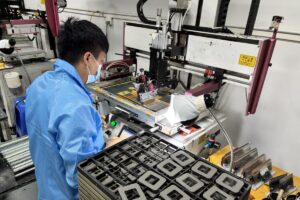
We see this pop up constantly with first-time orders transferred from other suppliers:
The sample logo looks crisp out of the box, but three months out in the field, the edges start flaking off.
Most shops blame cheap ink. We check our process instead. Before a single drop of ink touches a panel, we monitor three non-negotiable variables:
-
Surface Energy: If the glass or plastic substrate drops below 38 dynes/cm, nothing bonds properly—regardless of how expensive the ink is. We run dyne pen checks prior to every single print run. If it’s too low, it gets cleaned or re-treated.
-
Curing Temperature Curve: Different materials demand distinct curing limits:
-
Acrylic (PMMA): 60°C–70°C (any higher and it triggers thermal warping since acrylic softens around 80°C–90°C).
-
Glass: 165°C (handles higher temperature ranges for fast, stable polymerization).
Curing acrylic at glass oven settings warps the panel. Curing glass at acrylic levels leaves the ink partially unpolymerized. Both mistakes look identical on the surface—peeling ink—but have completely different roots.
-
-
Mesh Tension: Screen-printing mesh has to stay locked in a tight tension window (typically 18–25 N/cm²). Slack mesh equals blurry boundaries and scrap parts. Correct tension delivers sharp edges and uniform ink thickness every time.
If your supplier can’t explain these three factors clearly, they’re guessing. And you’re funding that guesswork via field failures.
10、What Is the “Dead Front” Effect — and Why Is It So Hard to Make?

“Dead Front” styling is a standard requirement for high-end HMI designs—especially across smart home controllers, premium industrial machinery, and automotive dashes.
The concept is simple: When the display is off, the cover glass presents a seamless, solid black look with zero visible screen boundaries.
When powered on, indicators and graphics cleanly punch through the dark glass matrix.
It looks fantastic. It is also one of the hardest production challenges in the shop.
Why Dead Fronting Goes Wrong:
-
Precision Silk-Screening: The ink masking layers must be completely uniform. Any minor thickness variance shows up as ugly dark patches or light bleeding when lit.
-
Glass Flatness: Substrates must be perfectly flat prior to printing. Warped glass leads to uneven ink deposits and visual distortion.
-
Opacity Calibration: Too dense, and the active screen looks dim and gray underneath. Too thin, and you can clearly see the outline of the display box while the machine is powered down.
-
Backlight Management: Design layouts must block stray light leakage around edges, matching tightly with the underlying module.
Dead Front isn’t just a simple coating job; it is a strict manufacturing discipline.
[INTERNAL LINK: /products/glasssmart-switch-touch-panels/customized-dead-front-hidden-display-glass/]
If your next project involves a Dead Front layout, verify that your supplier has specific production experience with this exact application, not just basic glass cutting.
11、FAQ — 6 Questions We Get Asked Most Often
Q1: What is the maximum operating temperature for cover glass on industrial HMI?
Acrylic (PMMA): ~80°C–90°C (exceeding this triggers rapid thermal deformation).
Chemically Strengthened Glass: ~300°C.
Gorilla Glass: ~400°C.
Always check the glass transition temperature (Tg) instead of relying on generic material tags. Keep in mind that the adhesive or optical bonding layers usually fail long before the glass substrate itself gives out. Your system is only as durable as its weakest layer.
Q2: How do you test cover glass durability for harsh factory environments?
We run four baseline stress tests on every custom configuration:
- Thermal Shock: −40°C to +85°C across 100 cycles to mimic unconditioned, volatile plant environments.
- Drop Ball Impact: A standardized steel ball dropped from fixed heights to check structural resilience.
- Surface Scratch Resistance: 200g load tests run for 5,000 cycles on linear abrasers.
- Chemical Resistance: Direct exposure to industrial lubricants, sweat, and cleaning solvents to ensure zero degradation.
Every sample must clear all four tests before full production begins.
Q3: What is the difference between chemically strengthened glass and thermally tempered glass?
| Chemically Strengthened | Thermally Tempered | |
| Process | Ion-exchange bath at ~400°C (sodium ions swapped out for larger potassium ions) | Heated to ~650°C, then rapidly air-quenched |
| Ideal Thickness | Thin formats (0.3mm–2mm) | Thick formats (4mm and up) |
| Best Fit | HMI covers, mobile tech, automotive instrument clusters | Architectural glass, heavy doors, vehicle side windows |
For slim industrial HMI designs, chemical strengthening is the absolute industry standard. Thermal tempering builds strong outer skins, but forces you to use much thicker glass—defeating the purpose of a compact, lightweight panel interface.
Q4: Can you supply custom-shaped cover glass complete with silk-screening?
Yes—this is our core specialization.
Typical Workflow:
- Customer Provides: CAD drawings (dimensions, tolerances, cutout locations—the “skeleton”) + vector artwork files like CDR/AI (graphics, alignment, Pantone color codes—the “skin”) + reference PDFs for engineering sign-off.
- We Deliver: Pre-quote DFM (Design for Manufacturing) feedback, rapid prototyping samples (3–5 days for plastics, 10–15 days for glass), scalable production runs, and flexible low-minimum trial options (10–50 pcs). Full surface finishes (AR, AG, AF) are fully customizable.
[INTERNAL LINK: /products/customized-professional-services/]
Q5: How can I audit an overseas cover glass supplier remotely?
Remote audits require looking at the right documentation checkpoints. Make sure to request:
- Live video walk-throughs of active production lines (insist on real-time video checks rather than pre-recorded loops).
- First Article Inspection Reports (FAIR) showing exact dimensional and material verifications for initial parts.
- Traceability certificates confirming ISO 9001, RoHS, and REACH compliance tied to lot numbers.
- Detailed DFM review notes indicating what suggestions the team made to optimize your drawings before quoting.
- Client references within your specific sector to verify long-term field stability.
If a vendor hesitates or refuses to share these files, treat it as a major red flag rather than a shortcut.
Q6: Why do some panels develop micro-cracks post-installation even after passing factory checks?
This is one of the most frustrating field issues in display manufacturing, and it almost always points to fabrication processing rather than raw material defects.
- Incomplete Annealing: If internal stress isn’t thoroughly relieved during heat treatment, parts look fine out of the box, but delayed micro-fractures trigger once assembly screws or tight mounting gaskets apply clamp pressure.
- Edge Micro-chipping from Poor CNC Feed Rates: Invisible microscopic chips left along cut perimeters act as stress concentrators. Under constant shop floor vibration or thermal cycling, those mini-chips spider-web into full cracks.
How we prevent it: Every production run follows strict temperature-logged annealing curves.
CNC parameters are dynamically tailored to match specific material types and thicknesses instead of running generic feed speeds.
Edges undergo high-magnification inspections post-cutting, not just a casual check before boxing.
Always ask how your supplier protects edge integrity—cracks almost always start on the edge.
12、Your Next Step — Stop Buying “Glass,” Start Buying “Certainty”

By this point, it’s clear that sourcing industrial HMI cover glass isn’t a commodity desk job. It directly impacts your machine’s uptime, your brand’s reputation, your warranty overhead, and your delivery schedules.
You have two paths forward:
-
Option 1: Email your CAD files to ten random vendors, hunt for the lowest price, wait for samples, and hope nothing shatters down the road.
-
Option 2: Send your files to us. We will provide:
-
A comprehensive DFM review highlighting potential mechanical risks before building molds.
-
Honest material suggestions mapped to your operational environment (instead of pushing whatever material happens to be collecting dust on our shelves).
-
A rigorous pre-quote engineering check handled by manufacturing specialists.
-
Transparent, itemized pricing with zero surprise add-ons later.
-
Option 2 doesn’t cost more. It just starts with a conversation.
No high-pressure sales tactics.
We built Winson Optics on the principle that if we’re the right engineering partner for your application, it will show—and if we aren’t, we’ll tell you upfront.
Iris wouldn’t run it any other way.
[INTERNAL LINK: /contact-us/]
Winson Optics — At Winson, We Don’t Just Make Lenses. We Safeguard Your Precision.
