
Our Process
Every Winson Optics order follows a rigorously engineered 4-stage workflow -- designed to eliminate supply chain uncertainty and deliver zero-defect optical components to your facility, anywhere in the world.
Technical Consultation
Precision starts before production. Our engineering team -- led by Iris and backed by 15 years of manufacturing experience -- works directly with your procurement and R&D teams to translate requirements into manufacturable specifications.
Accepted Drawing Formats
Material Selection Guidance
What We Clarify in Stage 01
- Optical performance targets (transmission, wavelength range, surface flatness)
- Dimensional tolerances and geometric constraints from your CAD drawings
- Artwork color matching via Pantone codes from your CDR files
- Surface treatment requirements (AR / AG / AF and coating specifications)
- Compliance requirements: RoHS, REACH, ISO 9001 documentation needs
Response within 24 hours. Send your drawings to [email protected]

Manufacturing Workflow by Material
- 1 Cut first
- 2 CNC edge grinding
- 3 Surface polishing
- 4 Screen printing
- 5 Coating (AR/AG/AF)
- 1 Sheet preparation
- 2 Screen printing
- 3 UV / thermal curing
- 4 Surface treatment
- 5 CNC cutting (last)
Precision Manufacturing
Our Shenzhen cleanroom facility runs automated production lines with high-precision spectral analyzers and CNC machining centers. Every process parameter is logged and traceable -- because certainty is built into our manufacturing DNA.
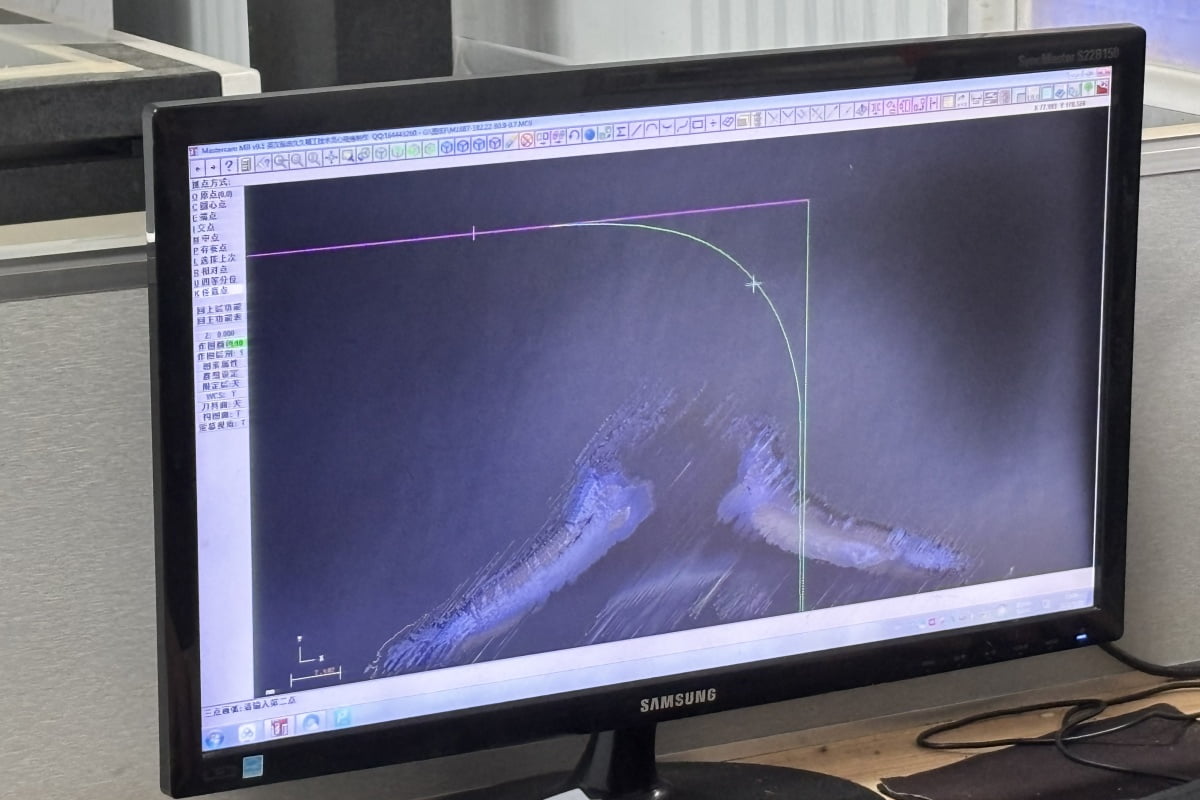
CNC High-Precision Machining
Computer-controlled milling and grinding achieve tight dimensional tolerances. Glass substrates are cut first; plastic substrates undergo CNC as the final step to preserve print integrity and edge quality.
Surface Treatment Options
Additional coatings available upon specification. Note: UV-curing composite materials are incompatible with UV post-processing -- our engineers will flag this during consultation.
Automated Screen Printing
Multi-color silk-screen printing on standard 50×70 screens. Each ink layer is thermally cured at 60-70°C for ~30 minutes before the next is applied -- preventing thermal deformation while ensuring adhesion integrity.
Triple-Layer QC System
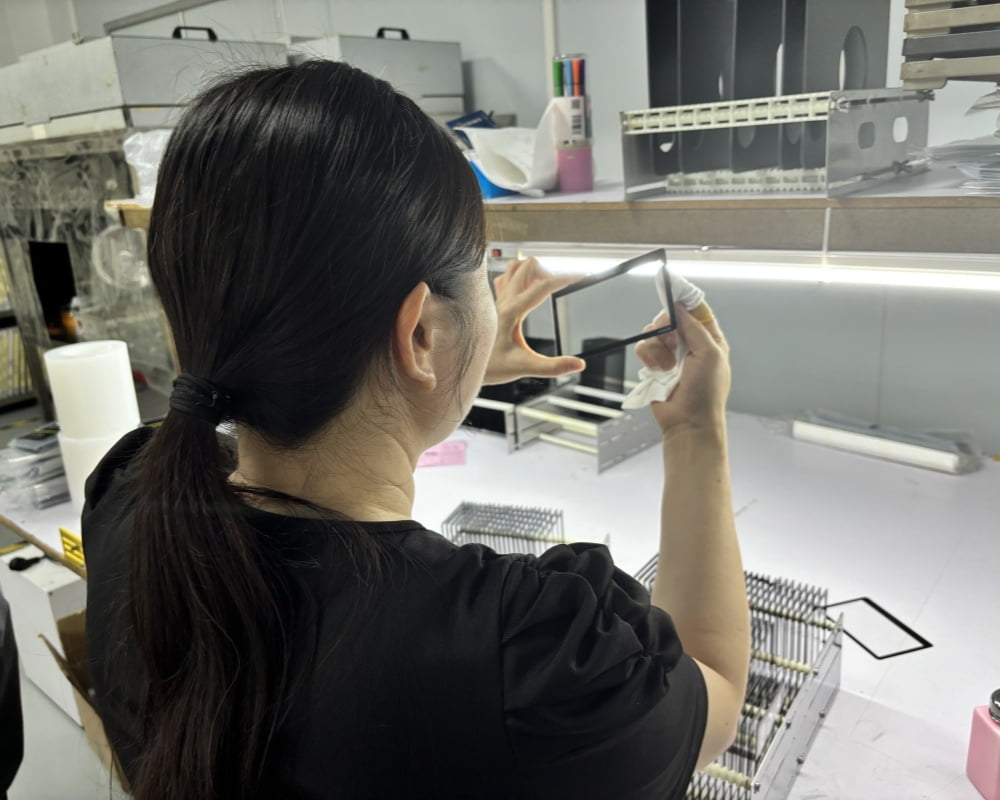
Our quality control architecture is built on three independent checkpoints -- IQC, IPQC, and FQC -- ensuring defects are caught at the source, not at your receiving dock. This is what Iris calls "Chief Auditor" level oversight: the same rigorous scrutiny she applied as a professional procurement manager, now embedded into every production run.
Incoming Quality Control
Raw Material Inspection · Before Production Starts
Every incoming batch of raw material -- whether sapphire blanks, borosilicate sheets, PMMA panels, or PC substrates -- is inspected against your specification before it enters the production line. No compromised material enters our cleanroom.
In-Process Quality Control
Real-Time Process Monitoring · During Production
Our QC engineers conduct sampling inspections at every critical production node -- post-CNC, post-printing, and post-coating. Process parameters are logged digitally, creating a full traceability record for each production batch.
Final Quality Control
100% Pre-Shipment Inspection · Before Every Box Is Sealed
Before any shipment is approved, every single component undergoes full FQC inspection -- not sampling, not statistical estimation. This is the "zero-defect delivery" commitment Winson Optics makes to every international client.
Safe Packaging & Global Logistics
An optically perfect component that arrives damaged is worthless. Our packaging engineering is designed specifically for fragile precision optics -- protecting your investment through the full international shipping journey, from our Shenzhen facility to your facility anywhere in North America or Europe.
Packaging Specifications for Precision Optics
Global Shipping Routes from Shenzhen

Packaging Checklist Before Shipment
-
FQC sign-off completed and documented
-
Individual cleanroom film wrapping applied
-
Custom foam tray insert positioned and verified
-
Desiccant packs and humidity indicator inserted
-
Full document package included in shipment
-
Tracking number shared with client within 24h of dispatch
"Having spent 12 years on the procurement side, I know exactly what it feels like to receive a damaged shipment or a non-conforming batch. That anxiety is precisely why we built these four stages -- not as a checklist, but as a commitment."