
01 The Challenge: The Flatness Nightmare — Breaking the Aspect Ratio Barrier
-
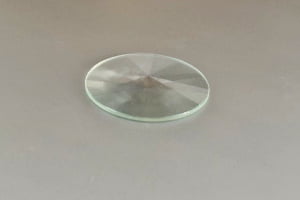
The Structural Fragility: Designing a circular window with a diameter-to-thickness ratio exceeding 100:1 created a part so delicate that standard handling caused immediate physical bowing.
-
The Manufacturing Failure: Internal trial data confirmed that conventional mechanical clamping exerted uneven stress, causing “edge-roll” effects and inconsistent flatness that would render the client’s sensors useless.
-
The High-Stakes Risk: In high-precision imaging, any micron-level deviation isn’t just a flaw—it’s a complete system failure that threatens the client’s entire product launch.
02 Our Actions : Proactively Optimizing Process Logic
-
In-Process Risk Identification: Upon identifying the warping trends in the pilot run, Winson’s team proactively halted the line. We refused to ship “marginal” parts that would later fail in the field.
-
Technical Responsibility: We absorbed the internal R&D costs to develop a specialized vacuum-adsorption mounting system, ensuring the glass remained in a neutral, stress-free state throughout the entire processing cycle.
03 Our Solution: Molecular-Level CMP and Vacuum Stress Compensation
-
Molecular-Level CMP: We implemented a Chemical-Mechanical Polishing (CMP) process, removing material at a molecular level to ensure a scratch-free finish without the damaging downward pressure of standard grinding.
-
Custom Vacuum Fixturing: We engineered a proprietary ceramic vacuum chuck to provide uniform atmospheric support across the 1.5mm thin surface, preventing any structural “sagging.”
-
Laser Interferometry: Every unit was verified via 100% laser interferometry to ensure absolute parallelism across the entire clear aperture.
04 The Result & Value
-
Zero-Distortion Precision: Successfully achieved a verified surface flatness of < λ/4 and a roughness of Ra < 0.5nm, transforming a “high-risk” design into a mass-producible reality.
-
Supply Chain Resilience: By solving the deformation crisis at the manufacturing source, we boosted the mass-production yield by 35%, protecting the client from months of delay and wasted material costs.
-
Engineering Certainty: The final components provided a flawless protective barrier with zero optical noise, securing the client’s reputation for sensor accuracy.
05 Conclusion
“Engineering Certainty” is born from the courage to stop and re-think.
By identifying the “Deformation Nightmare” before it reached the assembly line, Winson Optics turned a technical vulnerability into a competitive manufacturing advantage.