
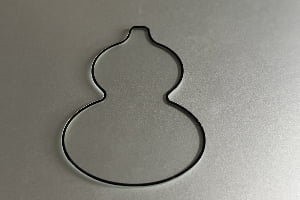
01 The Challenge :The Risk of Edge Chipping Caused by Complex Geometric Shapes
-
The Complexity: The “Gourd” design required multiple asymmetrical R-angle transitions, making the glass edges extremely vulnerable during processing.
-
The Production Pain Point: Initial internal trials showed that traditional abrasive wheel cutting resulted in a 25% chipping rate. For a B2B project, this level of instability represents a significant supply chain risk.
-
Aesthetic Sensitivity: These panels are used in premium smart home and beauty devices with ultra-narrow silk-screened borders. Any microscopic edge cracks or dimensional deviations would be magnified after printing, leading to mass rejection of finished parts.
02 Our Action : Proactively Optimizing Process Logic
-
In-Process Identification: Upon identifying the high chipping rate in the pilot run, Winson’s team did not proceed with mass production. Instead, we halted the line to conduct a comprehensive stress distribution analysis.
-
Strategic Pivot: We decided to abandon conventional cutting techniques. Our engineering department prioritized a technological upgrade, moving toward a dual-axis linkage precision CNC grinding strategy to ensure smoother transitions across all curves.
03 Our Solution :Precision Grinding and Stress Relief
-
Custom Tooling: We developed and deployed specialized micro-diamond tools specifically engineered for high-precision contouring of irregular glass shapes.
-
Stress Management: Our team re-engineered the cooling lubricant’s pressure and flow direction. This specific adjustment successfully neutralized the stress concentration that typically occurs during non-linear cutting.
-
Advanced Motion Control: By utilizing dual-axis synchronized grinding, we achieved a constant tangential contact point, eliminating the “jerking” motion that causes edge fatigue.
04 The Result & Value
-
Unprecedented Yield: The edge chipping rate was successfully reduced from 25% to under 0.3%, ensuring a stable and predictable supply for the client’s mass production.
-
Structural Excellence: The finished panels successfully passed a 1.2-meter drop test, verifying that our refined processing method preserved the inherent strength of the material despite its complex shape.
-
Cost Efficiency: By resolving the defect issue at the manufacturing stage, we prevented downstream waste and significantly lowered the client’s total cost of procurement.
05 Conclusion
At Winson Optics, we believe that “Engineering Certainty” is achieved through proactive problem-solving. By identifying manufacturing risks early and investing in superior technical solutions, we transform complex design visions into flawless, high-performance reality.