
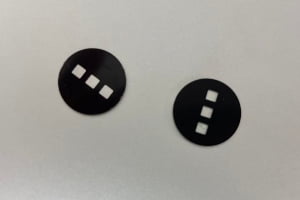
01 The Challenge: The Tolerance Trap — Why Standard Machining Fails Complex Step Designs
-
The Assembly Nightmare: The design requires a precise mechanical step (shoulder) to fit into a CNC-machined aluminum frame. A minor depth error creates a “scratched edge” or a loose fit.
-
The Precision Gap: Internal pilot runs showed that standard tooling vibration caused depth fluctuations exceeding ±0.05mm, which is unacceptable for premium industrial HMI standards.
-
The Visual Disruption: With multiple functional holes requiring silk-screening, the “Uncertainty” lies in the alignment. A 0.1mm offset between the physical hole and the printed border is visible to the naked eye, leading to high aesthetic rejection rates.
02 Winson’s Decision: Revamping Processes Before Quality Complaints Arise
-
Proactive Process Audit: Recognizing the inherent instability of the original sequence, Winson’s engineering team halted the batch after the first 10 samples. We refused to gamble on the client’s assembly line yield.
-
Technical Ownership: Instead of asking the client to relax tolerances, we pivoted internally to a more rigorous “Forming-Measurement-Refining” loop, absorbing the additional setup time to guarantee certainty.
03 Our Solution:Dual-Axis Step Grinding with Vision-Based Alignment Compensation
-
Precision Step Grinding: We deployed high-rigidity diamond-coated end mills and adjusted the CNC feed rate to perform a secondary “finishing pass” on the step depth, locking it at ±0.02mm.
-
Visual Compensation Printing: Abandoned manual jig alignment for a CCD-based visual registration system. The printer now “scans” the physical hole center before every stroke, achieving an alignment accuracy of 0.03mm.
-
Edge Stress Relief: Applied a specialized ultrasonic deburring process to ensure the inner edges of the holes are perfectly smooth, preventing micro-cracks during the silk-screening bake cycle.
04 The Result & Value
-
Zero-Gap Fitment: The final batch achieved a 100% assembly pass rate on the client’s production line, eliminating the need for manual sorting or re-work.
-
Aesthetic Perfection: The printed borders and physical holes are perfectly concentric, delivering the high-end “Medical-Grade” look required for the device.
-
Supply Chain De-Risking: By solving the alignment crisis at the source, Winson provided the client with a predictable, high-yield component that shortened their overall time-to-market.
05 Conclusion
“Engineering Certainty” means ensuring that what looks good on a drawing actually works in the assembly line. At Winson Optics, we bridge the gap between design intent and manufacturing reality through proactive technical intervention and obsessive precision.