
01 The Challenge: The Clarity Conflict — When Texture Meets Precision Backlighting
-
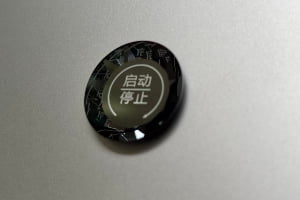
The Production Glitch: In the first batch, the backlit “Start/Stop” (启动/停止) characters appeared blurry. The light was escaping through the surrounding decorative texture, making the button look low-quality under low-light conditions.
-
The Tactile Dilemma: Automotive buttons require a specific “anti-fingerprint” and “scratch-resistant” coating. However, this extra layer made the laser etching inconsistent—sometimes too deep, sometimes too shallow to let the light through.
-
The Tier-1 Standard: Our client was supplying a major EV brand. Their tolerance for light bleeding was zero. If we couldn’t stabilize the optical isolation between the center icon and the decorative ring, the entire contract was at risk.
02 Winson’s Decision: Open Communication, Delving Deep into the Craft
-
The Accountability Call: Instead of sending out “borderline” samples, I called the client’s engineering lead. I told them: “We’ve seen the light-bleeding issue in the mass-run samples. We’re not shipping these. Give us 72 hours to re-calibrate the multi-layer blocking process.”
-
Bridging the Gap: I spent those 72 hours on the floor with our laser technicians. We realized we needed to change the order of operations—printing the blocking layers after the texturing but before the final icon etching. It was a risky move that increased our internal complexity, but it was the only way to ensure the certainty the client needed.
03 Our Solution:Multi-layer Optical Isolation and Dynamic Laser Compensation
-
Optical Isolation Layering: We developed a specialized “Silver-on-Black” triple-layer silk-screening process. This created a total light-block behind the decorative ring while allowing the center icon to remain perfectly translucent.
-
Dynamic Laser Etching: We upgraded to a high-frequency fiber laser with a 0.01mm focal point. This allowed us to “bite” through the top coating with surgical precision, ensuring the characters remained crisp without damaging the underlying substrate.
-
Automated Light-Tunnel Testing: I implemented a 100% dark-room inspection gate. Every button is now tested under 500-lux backlighting to ensure no light “ghosting” occurs around the edges of the characters.
04 The Result & Value
-
Automotive-Grade Perfection: The final icons are so sharp they look like they’re floating in the glass. We achieved a 99.5% yield rate, meeting the strict Tier-1 automotive quality standards.
-
Zero Aesthetic Rejections: Since the implementation of our new sequence, we haven’t had a single rejection for light leakage or character misalignment.
-
The Trust Dividend: The client was so impressed by our transparency and quick technical pivot that they awarded us the contract for the entire center console interface for their next-gen model.
05 Conclusions
In the automotive world, there’s no room for “good enough.”
This project reminded me that my job isn’t just to supply parts; it’s to protect my client’s reputation.
At Winson Optics, we turn production crises into opportunities to prove why we are the most reliable partner in your supply chain.